Shortage Sharing Project
Shortage-sharing agreements have been implemented for centuries in New Mexico. The main characteristic of these agreements is that during drought conditions, the way water is distributed shifts to prioritize that all users keep access to at least some water. This characteristic contrasts with the doctrine of prior appropriation, which allocates water by the chronological order in which the water was put to beneficial use.
Like most Western states, New Mexico's water law is based on the prior appropriation doctrine. This doctrine gives preference to those with the oldest water rights in times of shortages. If there is a shortage, the senior water rights holders can demand that more junior water rights holders reduce or stop their water diversions for the senior appropriators to get their full share.
As the Southwest's two decades of drought deepens, there is an increased interest in finding tools to minimize the impacts of these sharp water delivery restrictions, known as curtailments. These restrictions can disrupt agricultural operations and cause economic and social harm. Water shortage-sharing agreements can be an alternative solution to prevent sharp curtailments during these drought periods.
View our Storymap
Sponsored by the Thornburg Foundation
New Mexico: Water Shortage-Sharing Agreements
This project began with our August 2022 listening sessions, which were made possible through a grant from the Thornburg Foundation. The Shortage Sharing Pilot Listening Session brought together participants that included Tribes, Nations, Pueblos, acequias, irrigation associations, ditch companies, OSE staff, academics, and conservancy districts. Through six panel sessions the participants discussed why, where, and how New Mexico communities have developed effective water-sharing agreements. These sessions led to the creation of the Shortage Sharing StoryMap as a tool to help explain the history and active locations of shortage sharing in New Mexico.
Learn more about our Shortage Sharing Project
Watch our playlist of Shortage Sharing Interviews on our YouTube Channel:
https://www.youtube.com/playlist?list=PLJ2Eyy55-igw9viow_orukpqAwo5YGnTa
Read our report
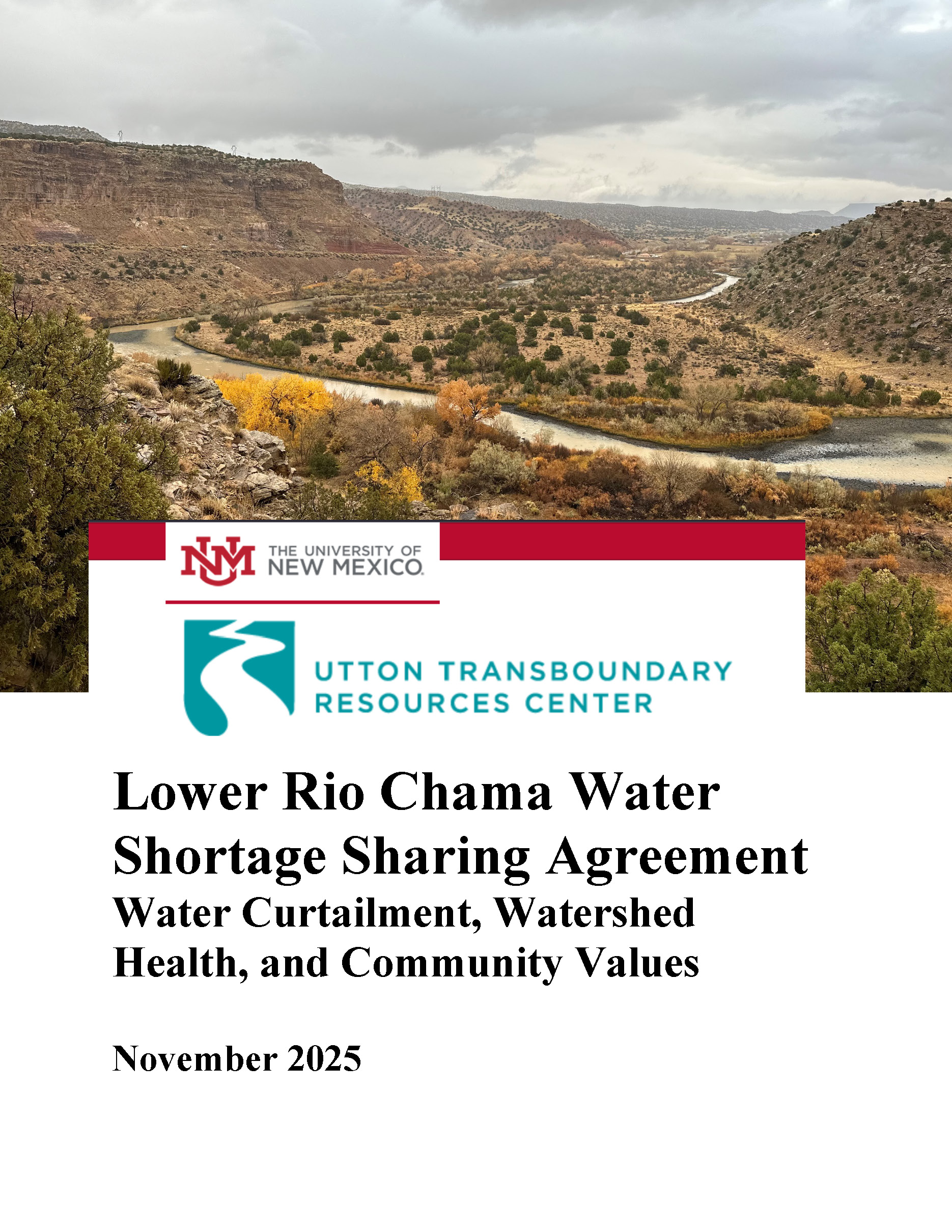
Lower Rio Chama Water Shortage Sharing Agreement Water Curtailment, Watershed Health, and Community Values
Published November 2025
A selection from the report's introduction:
Due to the new climate realities, irrigators have not consistently been able to rely solely on rainfall for irrigation. Furthermore, under prior appropriation laws, irrigators with senior water rights (i.e., older claims to water) can exercise their claim during times of water shortages by making a priority call on junior water users.
A priority call on water is an administrative process that a water user can exercise to access their full claim of water before junior water rights holders. A call by senior water users can leave junior water rights users with little to no water. Although the most common form of appropriation is strict priority administration, not all communities in the Southwest use this method during water shortages. Some have adopted a community-based approach, where senior users share water with junior users during periods of curtailment.
These alternative strategies to strict priority curtailments are widely used in New Mexico, which formalized them in 2004 as forms of alternative administration under state law in the Active Water Resources Management (AWRM) provision ... The New Mexico Administrative Code provides additional tools for addressing water shortages. Specifically, N.M. Admin. Code 19.25.13.7 outlines various forms of water administration, including “alternative administration" based on voluntary shortage sharing agreements. These agreements may involve percentage division, pro rata allocation, rotation of water use, or reduced diversions among affected water right owners. The state engineer and water master recognize such agreements, provided they do not impair the authority to regulate water distribution under the doctrine of prior appropriation. Our analysis finds that this agreement is an additional example where the benefits of proportionality —achieved through RCAA's rotation of water use— lead to a more robust and stable system.
Authors and Acknowledgements
Authors
Stephanie Russo Baca (russobaca@law.unm.edu)
Staff Attorney, Utton Transboundary Resources Center
University of New Mexico
Ana Gomez Lemmen Meyer (gomezlem@uci.edu)
Research Fellow, Deep Data Lab
University of California, Irvine
Research Assistant
Megan Phillips
Graduate Student
University of California, Los Angeles
Funding
This report was possible through a generous grant from the Thornburg Foundation. Grant: Native American Water Rights Settlement (NAWRS) & Rio Chama Water Shortage-Sharing Case Study.
Other Acknowledgements
We also thank Darel Madrid, Tyler Lystash, Tim Seaman, John Mumm, Sairis Perez-Gomez, Matt Harding, and Ashika Reddy for their time and input. Updates were completed by Rin Tara, July 2026.